Recently, Miura (my wife) and I went to NYC to celebrate my birthday. One of the places we visited was Ellis Island, the most famous historic immigration entry point in the USA (Ellis Island on Wikipedia). While we were there, we found Miura's great grandparents on the Wall of Immigrants; an emotional find given they arrived at Ellis Island from Poland in the 1930's, narrowly escaping the fate of millions of fellow Jewish Poles. Miura confirmed the details with her grandmother, which led her to explore more about her ancestry online.
Later that night, I was having trouble sleeping, so I decided to find a family tree website and start looking at my own ancestry. I tried a few of those sites when I was a teenager, but my father's lineage was incredibly difficult to trace due to largely comprising impoverished rural Appalachians. For example, my dad's grandfather (who never had electricity in his home despite living until 1984) is only documented in two US Censuses and an official death certificate. There is no record of his birth, I cannot find record of his marriage or divorce to my great-grandmother, and his gravestone is in an unmarked cemetery somewhere in the mountains of East Tennessee.
However, I did not encounter the same roadblocks as previous attempts and successfully traced each of my family tree branches back to at least 1660. I used the FamilySearch app (FamilySearch website — not sponsored; I just appreciate the service), which provides access to publicly released government documents, such as certificates of birth, death, marriage, and more, and uses crowd-sourcing to attribute names found in these documents to "profiles" for individual people.
As I traced my family tree back, I made sure to verify that the documents attributed to each of my ancestors seemed accurate and submitted corrections when necessary. For example, my great grandfather shared a surprising number of commonalities with someone unrelated in Oregon, over 2000 miles away. Both were named "William Locke", both were born around 1910, both married women named "Lula Mae", and both had surprisingly little government documentation available.
Sadly, I also confirmed I am not related to the famous John Locke (John Locke on Wikipedia), whose similar name caused my thesis advisor much frustration (Read More).
However, I still found a lot of neat individuals on both sides of my family, and the two I want to highlight today are William and Mary Dyer, my 11th Great-Grandparents. (Note for this section: name spellings were not as standardized back in the 1600s as they are now, so you may see their names spelled as "Dyar", "Dyre", "Dier", or other spellings in old documents, but "Dyer" is what most online resources use.)
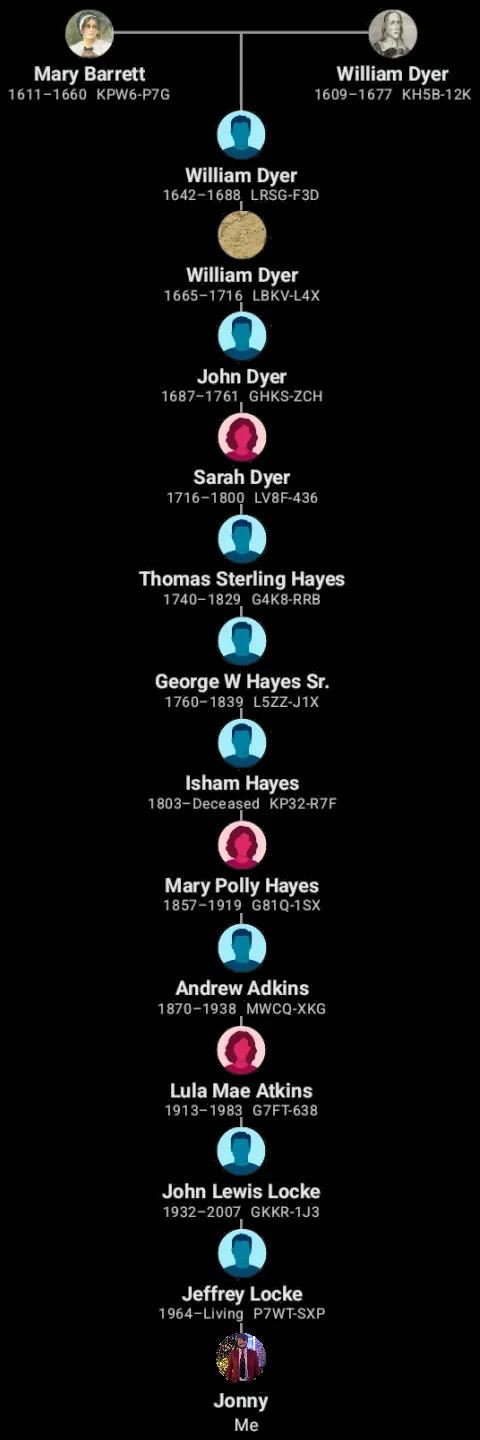
William was born in Lincolnshire in 1609 and Mary in London in 1611. In the early 1630's, the two met while William was working as a fishmonger's apprentice in London, and they got married shortly after in 1633; 390 years before I got married. Both were Puritans (Puritans on Wikipedia) who wanted to reform the Anglican church instead of separating from it, but due to the continual attempts of King Charles I to force his religious views on the church, the Dyers escaped with many other Puritans to Boston, Massachusetts Bay Colony, in 1635; also 390 years before I moved to Boston.
William was a fairly wealthy and influential individual; he was one of fourteen owners of the original fishing wharf in Boston (Source Blog), owned 42 acres of land in what is now Revere (more on that below), and had a house on the intersection of two important streets in Boston: Cornhill Road (now Washington St) and Milne Road (now Summer St). Further, after only 2 months of living in Boston, colony leadership appointed him as clerk for the project of "raysing a new Worke of fortification upon ye Fort Hill" (Source Blog, which claims to cite text from the Boston Town Records, 1634-1660).
After the Antinomian Controversy (Antinomian Controversy on Wikipedia), William signed a petition opposing the banishment of John Wheelwright, a Boston-area minister who clashed with the leadership's ideology (Source Book, pg 290). This signature led to William's own disenfranchisement and disarmament. In 1638, William and Mary Dyer moved to Aquidneck Island with several other religious exiles from Massachusetts Bay, where William signed the Portsmouth Compact, the founding document for what is now Rhode Island (Left). One year later, William signed the Newport Compact, founding what is now the city of Newport, Rhode Island (Right).
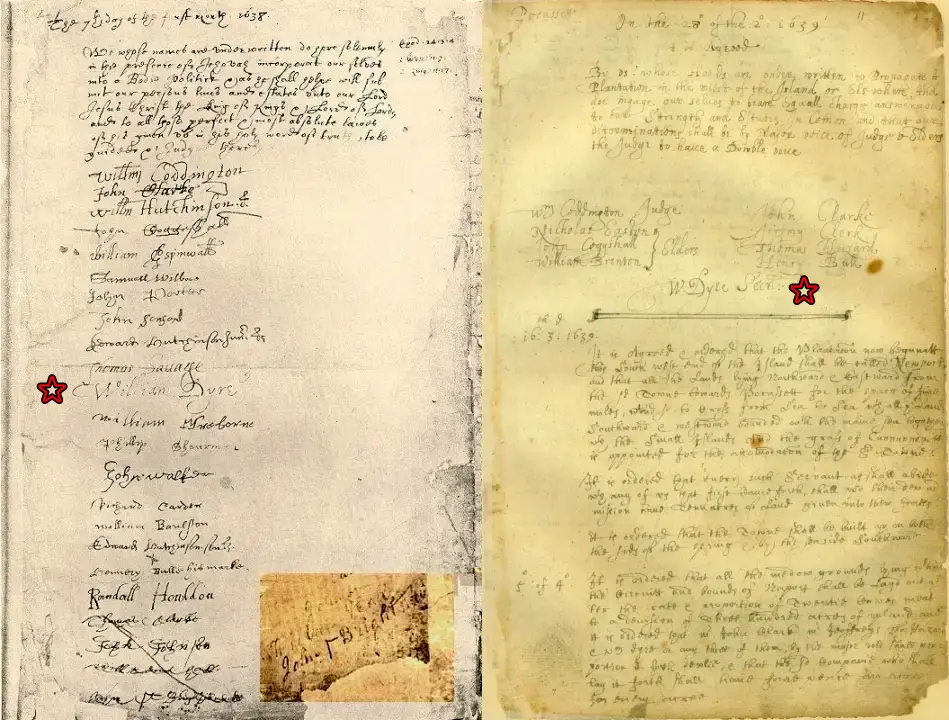
William's influence did not end upon his exile from Massachusetts Bay; he continued to serve in public office under many different roles. He pretty much immediately started serving as Secretary in the governing body of Aquidneck Island (see his signature on the Newport Compact above), then General Recorder in 1648, became Rhode Island's First Attorney-General from 1650-53, a member of the general court in 1661-62 and 1664-66, the General Solicitor for 1665-66 and 1668, and Secretary to the Council in 1669. He was also named as one of the "primary purchasers and free inhabitants" in the Rhode Island Royal Charter (Rhode Island Royal Charter on Wikipedia).
William also served in Rhode Island's military outfit; in a record from 1648, he is referred to as "Lieutenant" and in 1653 he was a "Captain" and "Commander-in-Chief upon the Sea" assigned to head an expedition against the Dutch. This expedition coincides with the Dutch building a defensive city wall in New Amsterdam (now New York), the same wall that served as the namesake for modern Wall Street (Article Link). Some 16 years after the English took New Amsterdam, William and Mary Dyer's son (and my 10th Great Grandfather), William Dyre Jr, became the 14th Mayor of New York, serving from 1680-1682.
Mary Barrett Dyer's story is arguably even more interesting than William's. William and Mary separately went to England in 1651; William went to argue before the Royal Council that Governor Coddington of Rhode Island should be deposed, but Mary's reason for the trip is unknown. While William returned to New England a few months after the Council's judgment, Mary spent 4 more years in England, during which she converted to the Society of Friends, more commonly known as Quakers (Quakers on Wikipedia). She was convicted by their message of grace, liberty, and church-state separation in contrast to the Puritan message of strict hierarchy and lawfulness.
The first Quakers arrived in New England in 1656. At the time, no laws or formal suppression of the Quakers existed, but it would not be long before both legal and societal pressures would target the Quakers. Many Quakers received ten or more lashes for speaking on their faith throughout the Massachusetts Bay Colony, including William and Mary's neighbor in Newport, Herodias Gardiner, who was whipped ten times when caught evangelizing in Weymouth. One Reverend from the Boston Church, John Norton, even called for the total banishment of Quakers from the colony enforceable by execution, a law that would be later enacted in October 1658.
Mary returned to New England after the anti-Quaker pressures had begun. After stepping off the port in Boston, she was immediately imprisoned. William travelled to Boston to ensure her release, which was granted on condition that she was never allowed to return to the colony and was not allowed to speak to anyone on their trip back to Newport.
Undeterred, Mary continued to travel throughout New England preaching her convictions, being arrested multiple times throughout the colonies. One of her later arrests occured in 1659, when she travelled to Boston to support 2 Quaker missionaries who had been imprisoned. She was arrested essentially upon arrival and brought before the Governor, John Endicott. After a few days of trials, the Governor sentenced Mary Dyer to death by hanging, to which she replied "The will of the Lord be done." When the Governor instructed the marshal to remove her, she stated "Yea, and joyfully I go."
Mary was scheduled to be the third Quaker executed on October 27, 1659. After watching the first two executions, Mary's limbs were bound and face covered with a handkerchief. She remained calm and prepared for her death, but an order of a reprieve was announced before her hanging. Her son, William, had petitioned the authorities to stop her execution. Colony leadership used the public display and timing of the reprieve to attempt to scare and dissuade Mary from her mission.
If anything, this stunt seemed to reinforce Mary's committment to her convictions. In a letter to the Massachusetts Bay General Court, she wrote: "My life is not accepted, neither availeth me, in comparison with the lives and liberty of the Truth and Servants of the living God for which in the Bowels of Love and Meekness I sought you; yet nevertheless with wicked Hands have you put two of them to Death, which makes me to feel that the Mercies of the Wicked is cruelty; I rather chuse to Dye than to live, as from you, as Guilty of their Innocent Blood: [. . .] When I heard your last Order read, it was a disturbance unto me, that was so freely Offering up my Life to him that gave it to me, and sent me hither so to do, [. . .] for he is my Life, and the length of my Days; and as I said before, I came at his Command, and go at his Command." (Source on Google Books)
The martyrs' courage in the face of persecution and even death built a popular sentiment against the authorities. Massachusetts Bay leadership wrote a letter to the recently crowned King Charles II in an attempt to vindicate their actions, suggesting that the reprieve of Mary Dyer softened the martyrdom of the other two Quakers. After leaving Massachusetts Bay, Mary spent the winter on Shelter Island, where she learned of the authorities' document and made a plan to return to Boston to challenge them.
Mary left Shelter Island in April 1660, and made it to Boston on May 21. After a short 10 days, she was summoned to appear before the General Court. In her interrogation, Governor Endicott asked: "You will own yourself a Quaker, will you not?" to which Mary answered: "I own myself to be reproachfully so called." Following her sentence of execution, Mary stated "I came in obedience to the will of God the last General Court, desiring you to repeal your unrighteous laws of banishment on pain of death; and that same is my work now, and earnest request, although I told you that if you refused to repeal them, the Lord would send others of his servants to witness against them."(Source on the Internet Archive)
The next morning at 9 AM, she was taken through the streets of Boston to the gallows. Once they arrived, the authorities offered her the chance to repent and be spared, but she refused, stating: "Nay, I cannot; for in obedience to the will of the Lord God I came, and in his will I abide faithful to the death." When the charges were cited to her, they indicated that she "was guilty of her own blood", to which she rebutted: "Nay, I came to keep bloodguiltiness from you, desiring you to repeal the unrighteous and unjust law of banishment upon pain of death, made against the innocent servants of the Lord, therefore my blood will be required at your hands who willfully do it; but for those that do it in the simplicity of their hearts, I do desire the Lord to forgive them. I came to do the will of my Father, and in obedience to his will I stand even to the death." She was given one more chance to repent, to which she said: "Nay, man, I am not now to repent."
Mary Dyer was determined to either end the persecution of Quakers or to die a martyr, and unfortunately fate had her accomplish the latter. At least, her direct "accomplishment" was martyrdom; indirectly, her execution played a role in Quaker Activist Edward Burrough's appeal to the new King Charles II, who in September 1661 issued a decree to the governors of the Royal Colonies to halt executions and imprisonments of Quakers. Societal abuse targeting Quakers did not cease for some 10-20 years, but the decree effectively ended the laws that repeatedly imprisoned Mary and her friends and eventually killed her and 3 others.
131 years after her execution, the ratification of the First Amendment to the US Constitution would provide the freedom of expression in both speech and religious belief that Mary Dyer deserved.
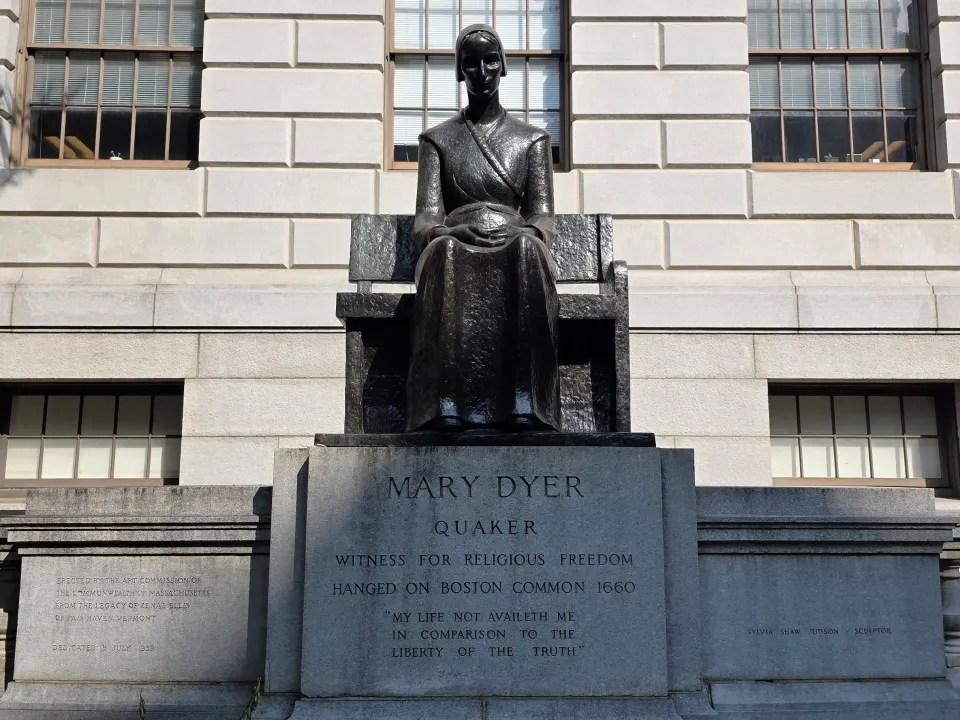
Just shy of 300 years after her execution, a statue of Mary Dyer was placed in front of the Massachusetts State Capitol building (though it has a common mistake on it: executions were not carried out in the Boston Common, but rather a place known as the "Common Lands" near Boston, about a mile south of the Boston Common - Source).
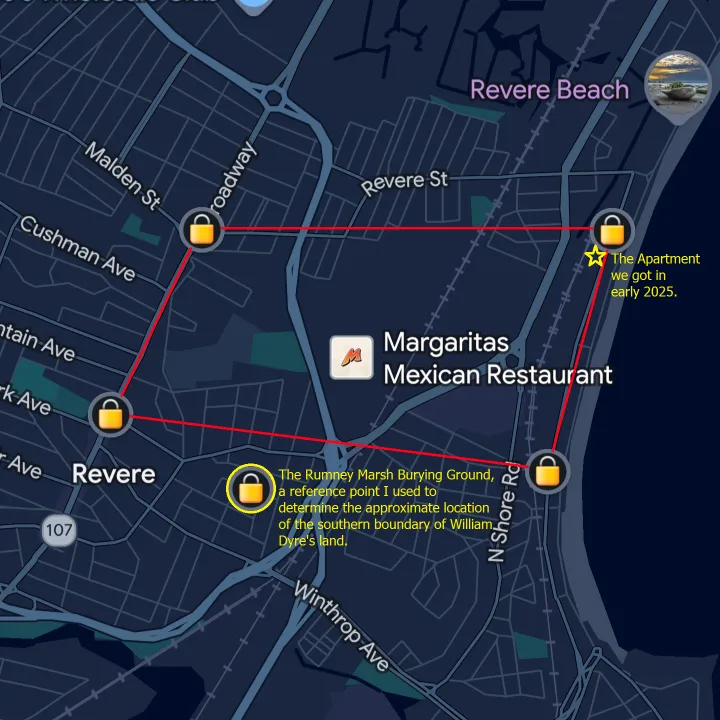
And finally, 390 years after William and Mary Dyer immigrated to Boston, my wife and I moved to Revere, a city that borders Boston on the north, and ended up leasing an apartment that sits on the northeast corner of land William once owned (Source Book, pg 33)! See the screenshot for the approximate plot boundaries laid out in Google Maps.
Given the abilities and convictions of my ancestors, I suppose it is no surprise I enthusiastically dedicate myself to the practice of debate.
Additional reading:
Portsmouth Compact on the Internet Archive
Newport Compact at Rhode Island State Gov Catalog
Rhode Island Royal Charter at Rhode Island State Gov Catalog
WikiTree Article on William Dyer
"The Dyers of London, Boston, & Newport" on Amazon
William Dyer on Wikipedia
Mary Dyer on Wikipedia