Rhetorician Locke
"Which One is the Odd One Out?" - An Analysis of Human Perception
Originally Written: March 19, 2025; Published: August 6, 2026
While viewing old notes saved to my phone, I found the below write-up about a meme from some time ago. I wrote this piece as a casual explanation of my thoughts to send to some friends, so it is not as formal as most of my other writings on this site. However, I decided to publish it here as I believe this photo prompts an interesting and entertaining thought experiment.
Before you read my analysis, spend a moment looking at this image and come up with your own answer and reasoning.
I'm curious to hear your thought process on this image. Once you finish reading the article, please use the link at the bottom to leave a comment explaining what answer you picked and why!
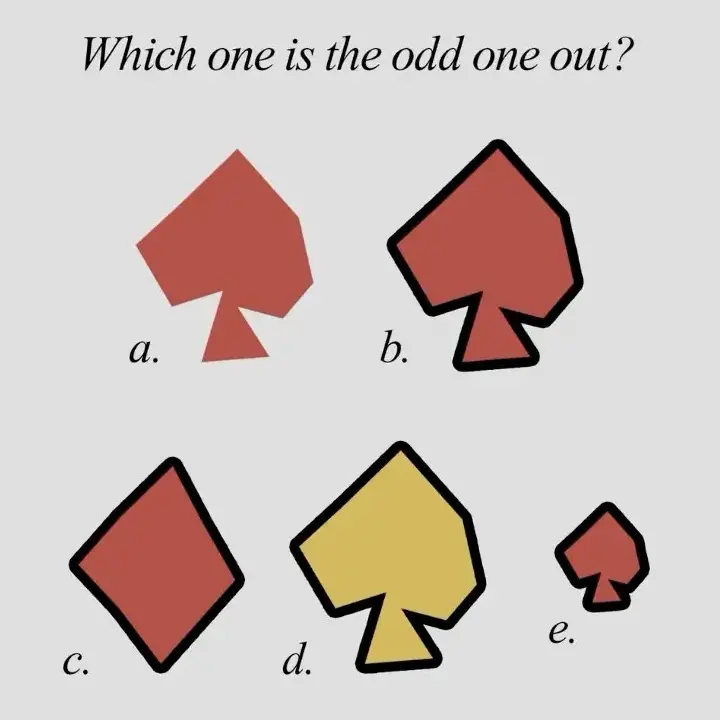
I love this image because everyone has their own answer and reasoning, which I believe exposes the real underlying questions. The stated question is merely a guise to provoke thought and prompt conversations about the real questions: "How do you process distinctions between objects?" or simply: "How do you think?" This is not just a troll question; it's a personality question, and I find it fascinating!
Someone who mentally humanizes the objects might answer C, because humans are diferent sizes (such as children; thus, E is not odd), skin colors (D), or have other cosmetic differences (A) while remaining human. To them, C is an abstraction bearing no resemblance to the original reference. To try this yourself, imagine B is an unmodified photo of a person. A could be that photo with a bald filter applied, D could be that person with a race swap filter, E could be that person with a filter to look younger or smaller. C is instead a photo of a house (or other non-human object).
This same logic of mentally assigning life to these objects might instead make someone say C isn't the odd one out, as some people look different physically, but that doesn't undermine their humanity. Just because you lost an arm in an accident doesn't mean you are less human. For these two hypothetical people, while the reference material did not change (both people saw the same 5 objects), the constructed symbols in their minds are different, because they rationalize abstract objects differently! Person 1 saw the different shape of C and mentally substituted it with a house. Person 2 saw the different shape of C and continued the personification of objects into it, with the unique shape being representative of a visible physical disability.
This puzzle is brilliant because it uses something very abstract (trying to identify the shape as a specific item shows that it's not really any specific thing; it's not quite a spade, it's not quite a tree, etc) but it retains easily discernable and recognizable features. It is a distinct shape despite not really looking like any tangible reference point. It has an easily discernable size. It has easily discernable details like color and outline. Most people can identify the same visual differences: that A is missing the outline present in all others, B has no single unique attribute (making it unique in that way), C is not the same abstract shape as the others, D is not the same color as the others, and E is not the same size as the others.
Where we differ is how our minds change the abstract data into references we more easily comprehend. In the face photo example, there's nothing in the puzzle to suggest the objects are people, but humanizing non-human things is one common way our minds make sense of abstracts or concepts we don't naturally understand (related: pareidolia). When no obvious correct answer is present for an abstract situation, our minds transform the present data into references we can more naturally process so we can find an answer we accept. It's a lot easier for most people to find and accept an answer when comparing natural, defined objects than abstract, interpretive objects.
With the humanizing example, we may also see more about how an individual identifies and prioritizes social in and out groups. In the face photo example, someone who defines their lived experiences by their race more than by other factors might find D to be the odd one out. That's not even to mention our subconscious assignment of minor details to certain traits or concepts, like masculine VS feminine or safe VS dangerous which could subtly influence in and out group assignment (check out tactile sound symbolism and bouba-kiki effect for similar linguistic phenomena).
Beyond humanizing them, some individuals will use other traits to assign uniqueness or conformity to abstract objects, like a preferential order for collectors. Shiny Pokémon hunters might be slightly more likely to point out D as the oddity, as they have been conditioned to look for unique, less common colors as a sign of rarity. People who work in QA might point out C or E, as the coloring could be less important for functionality than the shape or size. People with specific types of colorblindness might not see the difference in B and D, or maybe the difference will be much reduced, making other differences stand out more. People with Aphantasia (an inability to visualize things in one's mind) might think of the differences in linguistic terms as opposed to visually checking the differences. My wife is a great example of this; she has aphantasia and answered the puzzle with "E, because of the formal order of adjectives: Size, Age/Shape, Color, Origin, Material, Purpose".
As you can see, there are several different ways in which someone might devise an answer to this theoretically impossible question. I'm curious to hear your thought process on this image; please use the link below to leave a comment explaining what answer you picked and why!